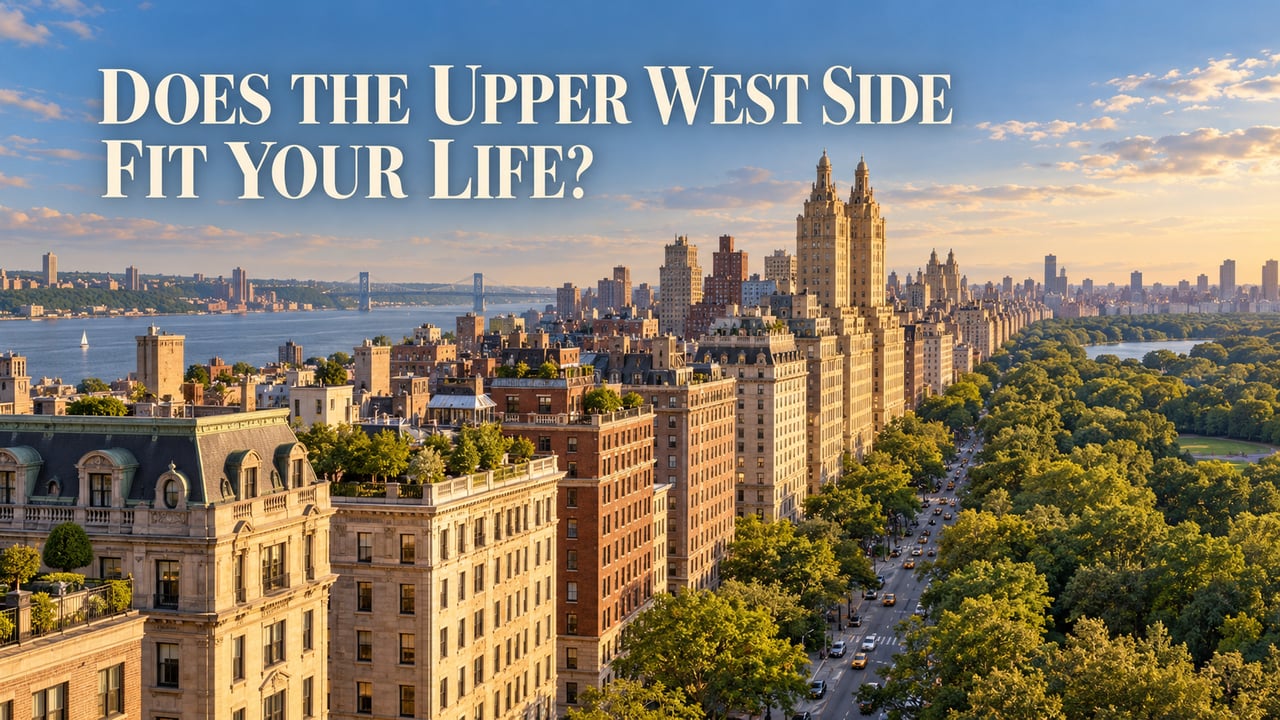
I'll let you in on something. When buyers tell me they want "a real neighborhood" in Manhattan, the kind where the guy at the bagel counter knows your order, I usually end up walking them north on Broadway. The Upper West Side between 72nd and 96th Street is about as close as this city gets to a hometown. It sits between two of the best parks in America, it's stitched together by some of the most convenient subway lines in Manhattan, and it has a food culture built on smoked fish, sourdough and very strong opinions.
But here's the thing. A neighborhood can be wonderful and still be wrong for you. So let's do this the way I'd do it if we were walking it together: commute first, then housing, then the good stuff, and finally a straight answer on whether it fits your life.
Quick facts: UWS, 72nd–96th Street
The lay of the land
Think of this stretch as a ladder lying on its side. The rungs are the numbered streets, and the rails are six avenues, each with its own personality. Central Park West is the grand one, lined with twin-towered prewar co-ops like the San Remo and the Beresford. Columbus and Amsterdam are the everyday avenues, full of restaurants, dry cleaners and sidewalk cafés. Broadway is the main street, with the big grocery stores, the subway and the crowds. West End Avenue is the quiet, dignified one, almost all apartment buildings. And Riverside Drive curves along the park with river views that make people forget they live in Manhattan.
In between, especially on the side streets from Central Park West to Amsterdam, you'll find rows of brownstones that feel more like Brooklyn than Midtown. Much of this area falls inside landmark historic districts, which helps explain why it still looks the way it did a century ago.
Four corners, four moods
Twenty-four blocks is a lot of ground, and the mood shifts as you walk north. Here's how I break it down for clients.
Around 72nd Street
The busiest hub. Verdi Square and the historic subway kiosk sit at the crossroads of Broadway and Amsterdam, the Dakota anchors the Central Park West corner, and Lincoln Center is a short stroll south. You get the most energy, the most shopping and the best express-train access.
Around 79th Street
The heart of the old Upper West Side. You'll find the Apthorp, Zabar's, the Museum of Natural History a few blocks east, and the M79 crosstown bus to the East Side. The river end leads down to the Boat Basin and the Greenway.
Around 86th Street
A true neighborhood main street. Barney Greengrass holds down Amsterdam, the 86th Street crosstown bus runs right through Central Park, and the Reservoir begins just inside the park. It's a little calmer than 72nd but still convenient on every side.
Up toward 96th Street
Quieter and a bit more relaxed, with the 2/3 express back in play at 96th. Symphony Space anchors Broadway at 95th, and Pomander Walk, a tiny storybook row of cottages tucked between 94th and 95th, is one of the neighborhood's best-kept secrets. Buyers often find a little more space for the money as they head north.
Commute and transit
This is where the Upper West Side quietly wins. Along Broadway, the 1 train stops at 72nd, 79th, 86th and 96th. The 2 and 3 run express, stopping at 72nd and 96th, and from 72nd the express hops straight to Times Square–42nd Street in one stop before continuing downtown to the Financial District and into Brooklyn. Over on Central Park West, the B and C stop at 72nd, 81st (right under the Museum of Natural History), 86th and 96th. That line takes you down the West Side to Columbus Circle, Midtown West and the Village. A quick caveat: the B runs weekdays only, and late at night the A takes over the C's local stops.
Getting to the East Side used to be the neighborhood's weak spot, but the M79 and M86 Select Bus Service routes cut straight through Central Park. If you work in Midtown, many residents simply walk or bike. The Hudson River Greenway runs through Riverside Park, so a car-free ride down the river to Midtown or beyond is a very real option.
My rule of thumb: the closer you live to 72nd or 96th, the better your express access. A spot near Broadway gives you the 1/2/3; a spot near Central Park West gives you the B/C. Before you fall in love with an apartment, walk from the front door to the train at 8:15 on a weekday. Listings never mention that part.
Housing stock and what it costs
The Upper West Side is co-op country. Most of the inventory sits in prewar co-op buildings with classic layouts: formal dining rooms, high ceilings, plaster details and the occasional maid's room that now doubles as a home office. You'll also find landmark buildings with real star power, like the Dakota at 72nd and Central Park West, the Beaux-Arts Ansonia on Broadway, and the Apthorp at 79th, plus a steady supply of postwar doorman buildings and a smaller number of newer condos.
Now the numbers. PropertyShark put the neighborhood's median sale price at about $1.4 million in the third quarter of 2026, up 3.3% from a year earlier. Within our stretch, a third-quarter report from Manhattan Miami showed condos between 79th and 96th Streets with a median of about $2.09 million across 327 sales, and co-ops at about $1.23 million across 442 sales. That gap matters. Co-ops usually cost less for similar space, but they come with board approval, financing rules and sometimes restrictions on subletting. Condos cost more but give you more flexibility. Neither is better. It depends on how you plan to live, how long you'll stay and whether you might rent the place out someday.
Renting first? RentHop's July 2026 data put the median one-bedroom at about $4,895 a month and the median two-bedroom at about $6,749. Prices move month to month, so treat those as a compass reading rather than a map.
Brownstones are the dream for a lot of buyers, whether that means a whole townhouse or a floor-through apartment inside one. They trade less often, and the condition varies a lot, so bring an inspector and a little patience.
Parks and outdoor space
Imagine having a front yard and a backyard, except the front yard is Central Park and the backyard is Riverside Park. That's the Upper West Side.
On the Central Park side, you've got Strawberry Fields at 72nd Street, the Great Lawn in the middle of the park, and the Jacqueline Kennedy Onassis Reservoir from 86th to 96th, with a running track that might be the most scenic jog in the city. On the river side, Riverside Park, designed by Frederick Law Olmsted, stretches along the Hudson with tree-lined paths, ballfields, playgrounds and the Soldiers' and Sailors' Monument at 89th Street.
Dog owners, you're covered. The 87th Street Dog Run in Riverside Park has separate areas for big and small dogs, and the Bull Moose Dog Run sits in Theodore Roosevelt Park, the green space wrapped around the Museum of Natural History.
One project to watch: the 79th Street Boat Basin, the city-run marina on the Hudson, has been closed since 2021. NYC Parks has an $89.2 million reconstruction planned, the state's environmental review cleared it this October, and boats are targeted to return around 2028. If you love the water, that's a nice future perk to keep an eye on.
Food and daily life
The Upper West Side eats like a neighborhood that's been feeding itself well for a hundred years. Zabar's at 80th and Broadway is a pilgrimage for smoked fish, coffee and babka, and the line at Barney Greengrass on Amsterdam at 86th, around since 1908, tells you everything about weekend brunch here. Levain Bakery's original shop on West 74th Street is where the city's cookie obsession took off. For everyday groceries, Citarella, Trader Joe's and a long list of local markets line Broadway.
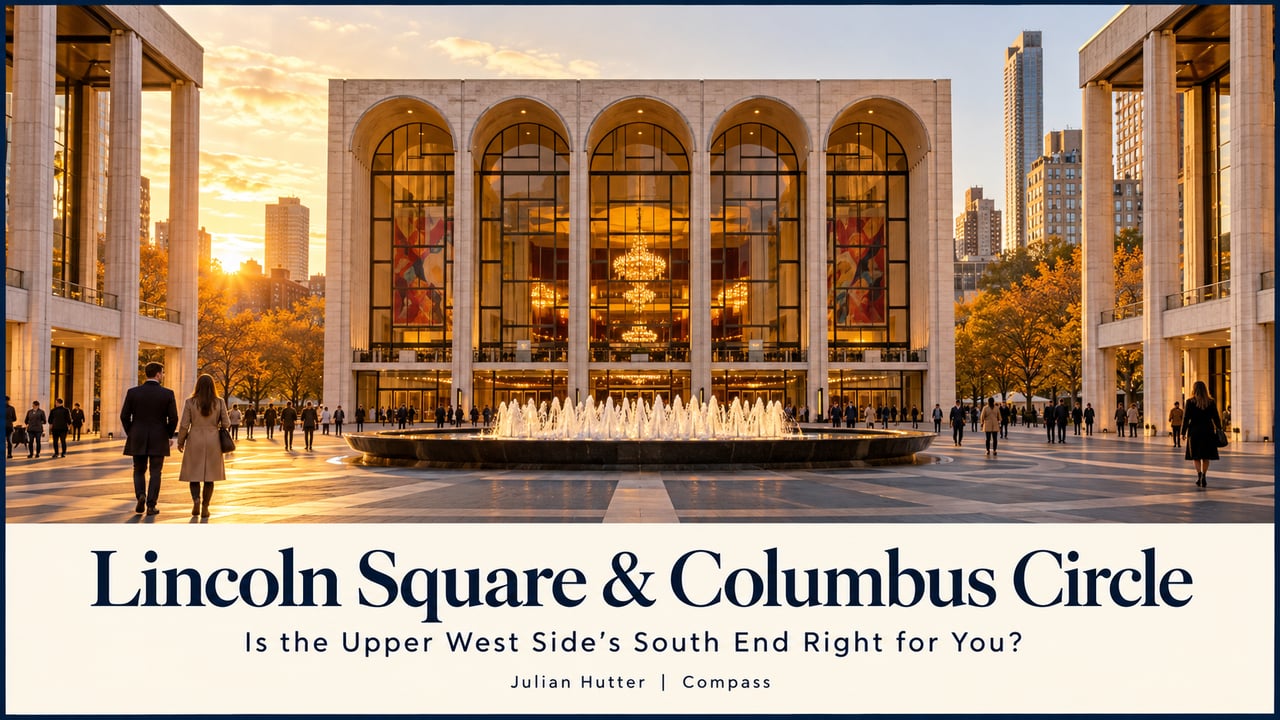
Culture is built in, too. The American Museum of Natural History, now with its striking Gilder Center, sits between 77th and 81st on Central Park West, with New York Historical right next door. The Beacon Theatre on Broadway at 74th brings in big-name concerts and comedy, and Symphony Space at 95th hosts readings, films and performances. Lincoln Center is a short walk or one subway stop south.
The neighborhood keeps evolving, too. West Side Rag tracks openings and closings almost weekly, and this fall's list includes new coffee spots, sandwich counters and restaurants. Some newcomers stick around and some don't, but the classics hold steady.
Noise and the feel of the place
Here's how it breaks down, street by street: Broadway and Amsterdam are busy, lively and sometimes loud, especially near the 72nd and 86th Street stations and along the 79th and 86th Street bus corridors. The side streets are a different world: quiet, leafy and residential, with stoops and window boxes. West End Avenue and Riverside Drive are among the calmest addresses in Manhattan.
The overall feel is residential rather than nightlife-driven. You'll find plenty of bars and late dinners, but this isn't the Lower East Side at 2 a.m. If you want a neighborhood where you can actually sleep with the window cracked, look at the side streets and the river blocks. If you want energy outside your door, a Broadway or Amsterdam address will give it to you.
Schools and safety: doing your homework
I'm a big believer in doing your own research on schools and safety, using official sources. This stretch of the Upper West Side is part of NYC Community School District 3. To see which schools serve a specific address, use the city's MySchools tool and InsideSchools for independent profiles. Always confirm zoning for the exact building, because lines can change.
For public safety information, the area is served by the NYPD's 20th Precinct, roughly south of 86th Street, and the 24th Precinct to the north. The NYPD's CompStat dashboard and NYC Open Data let you look up the latest numbers for yourself.
Is the Upper West Side right for you?
It's a great fit if you want:
Two major parks within a few blocks, wherever you land
Fast express-train access to Midtown and downtown
Prewar character: big rooms, real dining rooms, details you can't build anymore
A residential pace where errands are walkable and neighbors recognize you
Museums, concerts and Lincoln Center close to home
It may not be the right fit if you want brand-new construction at every price point, a nightlife scene outside your door, or the most square footage for your money in the city. In that case, I'd point you toward some of the neighborhoods coming up in this series.
Let's walk it together
Reading about a neighborhood is a start, but walking it is how you know. If the Upper West Side is on your list, I'd love to show you around: the avenues, the side streets, and the buildings that never seem to come up on the big search sites. Reach out any time, and we'll find the block that feels like home.
Julian Hutter, Compass
917-701-0509