New construction has a certain magnetic pull in New York City. Everything is untouched. The kitchen has never been cooked in. The amenities look like a hotel brochure. And there’s something appealing about being the very first person to live somewhere.
But new development is also one of the most misunderstood corners of the Manhattan market.
As a Manhattan real estate advisor who has guided buyers through both resale and new construction purchases for over 20 years, I’ve found that the deals that go smoothly are the ones where buyers understand what they’re really getting — and what they’re really paying — before they ever sign a contract.
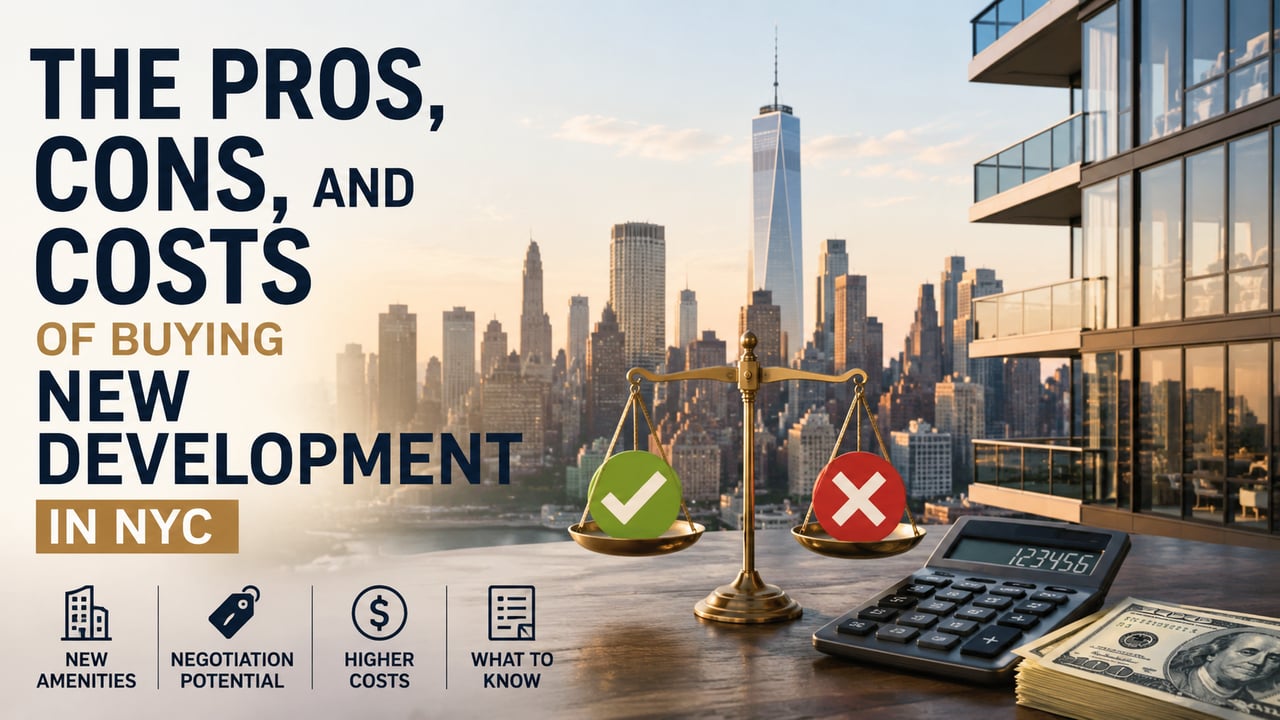
Here’s a clear-eyed look at the pros, the cons, and the true costs of buying new development in NYC.
What “New Development” Actually Means
In New York City, “new development” usually refers to a condominium being sold directly by a sponsor — the entity that built or converted the building — rather than by an individual owner on the resale market.
It can mean:
• A brand-new, ground-up condominium
• A conversion of an existing building into condos
• Unsold sponsor units in a building that’s been standing for years
Not every new development is still under construction. Some have been finished and occupied for months or years, with the sponsor still marketing the remaining units.
The Pros of Buying New Development
Everything Is New
Systems, appliances, windows, and finishes haven’t been touched. Many come with builder or manufacturer warranties that resale apartments simply don’t offer.
Amenities Built for Today’s Buyer
Newer buildings tend to offer more robust amenity packages — fitness centers, resident lounges, outdoor space, package rooms, sometimes even pools or private dining rooms. Buildings built decades ago weren’t designed with these expectations in mind.
No Co-op Board Approval
This is a big one. Sponsor sales are typically not subject to board interviews or the financial scrutiny that comes with a co-op purchase. If you qualify for financing — or you’re paying cash — you can generally move forward without a board deciding whether you’re the right fit for the building.
Room to Negotiate
Depending on how sales are going, sponsors can be flexible — on price, on closing cost credits, sometimes on finishes or upgrades. Early in a building’s sales cycle, or when only a handful of units remain, there’s often more room to negotiate than buyers expect.
A Blank Slate
Depending on timing, buyers sometimes have the ability to select finishes or make limited customizations before a unit is completed. That’s not something the resale market offers.
The Cons of Buying New Development
You Pay a Premium
New construction is priced at a premium over comparable resale apartments. You’re paying for “new,” and that premium doesn’t always come back to you right away if you sell in the first few years.
Limited Track Record
There’s no sales history to lean on. Comparable sales in the same building may not exist yet, which makes it harder to know with certainty whether a price is fair.
Construction and Punch List Issues
Even in beautifully built buildings, it’s common to encounter punch list items after closing — things that need adjustment, repair, or finishing. Sponsors are obligated to address these, but the process takes patience.
The Building Is Still Settling In
A new condominium doesn’t have an established financial history the way an older, resale building does. The board hasn’t been tested by a full annual budget cycle yet, and it takes time to see how well the building runs once the sponsor turns over control to the owners.
Closing Costs Are Meaningfully Higher
This is the part that surprises the most buyers — and it deserves its own section.
The Real Costs of Buying New Development
In a resale transaction, many closing costs are customarily paid by the seller. In a new development transaction, sponsors routinely shift several of those costs onto the buyer through the contract of sale. It’s one of the most important differences between buying new construction and buying resale, and it’s rarely discussed until buyers see it in writing.
Here’s what buyers should budget for beyond the purchase price:
NYC Real Property Transfer Tax (RPTT)
1% of the price for sales up to $500,000, and 1.425% above that. In most new development contracts, the sponsor requires the buyer to cover this — even though it’s traditionally a seller’s expense in a resale deal.
NYS Transfer Tax
0.4% of the price for sales up to $3 million, and 0.65% at $3 million and above. Like the NYC transfer tax, sponsors typically pass this along to the buyer as well.
The NYS Mansion Tax
This applies to any residential purchase — resale or new development — at $1 million and above, and it’s always paid by the buyer. It’s progressive, meaning the entire purchase price is taxed at the applicable bracket rate:
• $1M – $2M: 1%
• $2M – $3M: 1.25%
• $3M – $5M: 1.5%
• $5M – $10M: 2.25%
• $10M – $15M: 3.25%
• $15M – $20M: 3.5%
• $20M – $25M: 3.75%
• $25M+: 3.9%
For most buyers in the $1M to $3M range, this alone adds tens of thousands of dollars at closing.
Sponsor’s Attorney Fee
Most new development contracts require the buyer to reimburse a flat fee for the sponsor’s attorney — often somewhere between $1,500 and $3,000 — simply for preparing the contract.
Working Capital or Reserve Fund Contribution
Many sponsors require an upfront contribution, often equal to one or two months of common charges, to help fund the building’s reserve account.
Common Charges That May Rise Over Time
Sponsors sometimes subsidize common charges during the early sell-out period, or base initial charges on the completed offering plan budget. It’s worth understanding whether the number you’re quoted today reflects what owners will actually pay once the building is fully sold and stabilized.
Property Tax Abatements — and Their Expiration
Some new developments carry a property tax abatement, historically the 421-a program, now largely replaced by 485-x for projects that began construction after mid-2022. These benefits can meaningfully reduce your property taxes for a period of years, but they phase out — and eventually expire. When that happens, taxes can increase substantially. It’s worth asking, specifically, what abatement (if any) applies to the unit, how many years remain, and what the projected taxes look like once it ends.
Put together, buyer closing costs on a new development purchase in NYC often run 6% or more of the purchase price, compared with roughly 4% on a resale condo and 2% on a typical co-op.
Reading the Offering Plan (Don’t Skip This)
Every new development is sold under an offering plan — sometimes called the “condo bible.” It’s filed with the New York State Attorney General’s office and it governs nearly everything about the building: the budget, the bylaws, the sponsor’s obligations, warranty terms, and projected common charges and taxes.
Your attorney should review the offering plan closely before you sign a contract — the same way a co-op attorney reviews board minutes and financials. It’s not exciting reading, but it’s where the real answers live.
Is New Development Right for You?
There’s no universally right answer here. Some buyers value the predictability of new systems, modern amenities, and a straightforward purchase process without board approval enough to pay the premium. Others prefer the established pricing, known common charges, and settled history that resale offers.
The right choice depends on your priorities, your timeline, and how you weigh cost against convenience.
Whether you’re drawn to new construction for its amenities and ease, or you’re simply trying to understand what you’d actually pay at closing, it helps to walk through the numbers before you fall in love with a floor plan.
If you’re considering buying new development in New York City, I’d be happy to walk you through current offering plans, break down the true closing costs for a specific building, and help you decide whether new construction or resale makes more sense for your goals.
No pressure. No obligation. Just clear guidance.
Remember — Who You Work With Matters!