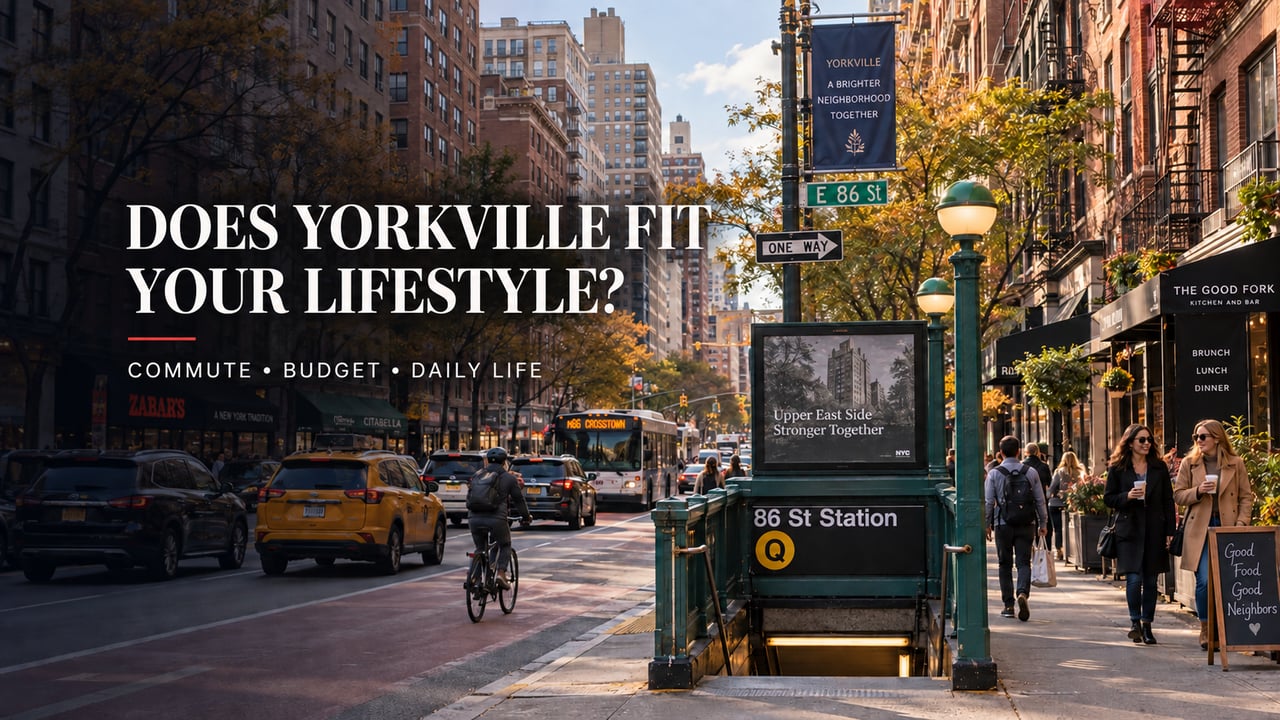
Yorkville can be an excellent fit for a Manhattan buyer who wants a residential Upper East Side neighborhood, useful subway access, parks near the East River, neighborhood restaurants, and a broad mix of co-ops and condominiums. It can also offer a different price-to-space equation than some blocks farther west or downtown. The tradeoffs are equally real: the walk to Lexington Avenue can feel long from the eastern edge, nightlife is more neighborhood-oriented than downtown, and the experience changes considerably from a quiet side street to First or Second Avenue.
The right question is not whether Yorkville is a good neighborhood in the abstract. It is whether a particular Yorkville apartment, building, block, and commute fit the way you live. Buyers should test the neighborhood against five practical issues: transportation, total monthly cost, housing stock, daily routine, and long-term flexibility. That approach produces a more reliable answer than any list of the best Manhattan neighborhoods.
Where Yorkville Begins and Ends
Yorkville is part of the Upper East Side, and its exact boundaries depend on whom you ask. A commonly used description runs from East 79th Street to East 96th Street, from Third Avenue to the East River. Some people draw the western boundary differently or treat the southern edge more loosely. For a buyer, the debate matters less than the actual block. An apartment near Third Avenue lives differently from one near East End Avenue, even when both are marketed as Yorkville.
How the Yorkville Commute Works
The Second Avenue Subway changed the Yorkville commute. The Q train serves East 86th Street and East 96th Street along Second Avenue, with the East 72nd Street station convenient to the neighborhood’s southern edge. That can make trips to Midtown and connections farther downtown far easier than they were when Yorkville depended mainly on Lexington Avenue service and buses.
The 4, 5, and 6 trains at East 86th Street remain important, as does the 6 train at East 96th Street. The practical choice depends on where the apartment sits and where the buyer travels. Someone living near Second Avenue may prefer the Q. A buyer closer to Third Avenue may use Lexington Avenue service. Express service can be valuable, but only if the walking time and final destination make the whole trip efficient.
Cross-town buses along East 79th, East 86th, and East 96th Streets connect Yorkville to Central Park, the West Side, and subway lines farther west.
Before making an offer, time the commute door to door during the hours you will travel. Check weekday, late-night, and weekend service on the MTA map. If step-free access matters, confirm the current accessible route for the specific station and entrance. A subway symbol on a listing is not a commute analysis.
What Your Budget Buys in Yorkville
Yorkville has often been considered a relative-value area within the Upper East Side, but relative value does not mean inexpensive. It means a buyer may find more space, an additional bedroom, or lower monthly carrying costs than in certain premium locations farther west or downtown. The comparison must use current listings and recent sales because price changes with the building, condition, floor, light, view, and exact avenue.
The neighborhood offers several housing types. Prewar walk-ups may have character and lower common charges, but stairs, laundry, and renovation needs can be decisive. Prewar elevator co-ops may offer larger rooms and established buildings, along with board approval, financing limits, sublet rules, and renovation policies. Postwar co-ops can provide practical layouts, elevators, laundry rooms, and full-service staff. Condominiums range from conversions to newer developments with modern systems and amenities, usually at a higher purchase price.
Compare the complete monthly cost rather than the asking price alone. Include mortgage payments, co-op maintenance or condo common charges, real estate taxes, insurance, utilities, and assessments. Review what the monthly charge covers. Two apartments with the same purchase price can create very different budgets when one has higher carrying costs or an assessment.
A buyer should also consider resale. A flexible layout, good light, elevator access, sensible monthly charges, and proximity to transportation can matter to future buyers. A dramatic amenity package may look wonderful, but somebody has to pay for it every month. Roof decks do not maintain themselves, despite their confident demeanor.
Building Styles and Apartment Tradeoffs
Start with the way the apartment must function. Do you need two true bedrooms, a home office with a door, an elevator, in-unit laundry, central air, outdoor space, storage, or room for a dining table? Does the building allow your pet? Can a washer and dryer be installed if the apartment does not have one? Are there limits on financing, pieds-à-terre, guarantors, gifting, or subletting? These details can eliminate a property long before paint colors matter.
Exposure deserves special attention. Apartments facing an avenue may receive more light and more street noise. Rear-facing homes can be quieter but may face walls, mechanical equipment, or interior courtyards. Higher floors can improve light and reduce some street sound, although rooftop equipment can create a different issue. Open the windows, stand in every room, and listen.
Daily Life Parks and Restaurants
Yorkville works well for buyers who want an active neighborhood without depending on a major tourist district. First, Second, and Third Avenues provide restaurants, cafes, bars, groceries, pharmacies, fitness studios, and everyday services. The selection changes over time, so buyers should map the businesses they will actually use instead of relying on a remembered version of the neighborhood.
Carl Schurz Park is Yorkville’s signature green space, with paths, playgrounds, dog runs, and East River views. The waterfront promenade and nearby East River Esplanade can be valuable for walking, running, or simply getting out of the apartment. Asphalt Green provides athletic and recreation facilities near East 90th Street, and smaller playgrounds and public spaces add options throughout the area. Central Park remains accessible, but buyers near the river should be honest about how often they will walk west to use it.
Yorkville does not feel like the West Village, SoHo, or the Lower East Side, and that is either a benefit or a drawback. Buyers seeking late-night destination restaurants and a downtown street scene may find the neighborhood too residential. Buyers who want useful local restaurants and a calmer return home may prefer it. The important distinction is not better or worse. It is whether the neighborhood’s pace matches yours.
Noise and the Exact Block
Yorkville can feel quiet on side streets, but broad neighborhood descriptions hide local noise sources. First and Second Avenues carry traffic and buses. East 86th Street is a major commercial and transportation corridor. The FDR Drive can affect homes near the river, depending on floor, exposure, window quality, and surrounding buildings. Construction, schools, playgrounds, loading zones, restaurants, and building mechanical systems can also change the experience.
Visit a serious apartment on a weekday morning, in the evening, and on a weekend. Listen from the bedroom during the hours you expect to sleep. Check whether a restaurant vents near the windows, whether trucks use the curb, and whether a nearby project is under construction. A quiet lobby proves only that the lobby is quiet.
School Considerations and Household Needs
School research must be current and address-specific. Buyers should use the New York City Public Schools Find a School tool to confirm zones, programs, admissions rules, and transportation. A Yorkville address does not automatically provide access to a particular school, and rules can change. Families considering private or parochial schools should confirm admissions, schedules, and the daily trip directly with each school.
Household needs extend beyond schools. A buyer with a stroller may prioritize an elevator, wide hallways, storage, and a route without steps. Someone planning to age in place may care about entry ramps, elevator reliability, bathroom layout, and proximity to medical care. A remote worker may need acoustic separation and reliable space for a desk. Pet owners should review building rules and the route to parks or dog runs.
These requirements should be divided into nonnegotiables and preferences. The distinction protects buyers from being seduced by a beautiful kitchen in an apartment that cannot support their daily life. New appliances are charming. Carrying a stroller up four flights is considerably less charming.
How to Evaluate Safety and Personal Comfort
Buyers often ask whether Yorkville feels safe. That question should be answered with objective information and personal observation, not a real estate agent’s label. Review the NYPD crime map and current 19th Precinct statistics. Visit the exact block and subway route at the times you would use them. Notice lighting, foot traffic, construction sheds, station entrances, and how you feel walking the route.
No neighborhood description can replace that work. Conditions vary by block and time of day, and different buyers have different comfort levels. An agent can identify public resources, building features, and transportation options, but buyers should make their own assessment.
Is Yorkville a Good Place to Buy an Investment Property
Many Yorkville co-ops restrict subletting, require owner occupancy for a period, limit the number of rental years, or prohibit investors entirely. Condominiums generally offer greater rental flexibility, but buyers must review the declaration, bylaws, waiver process, fees, taxes, and any restrictions on lease length. The building’s financial condition, insurance, reserve fund, planned capital work, and assessment history also affect risk.
An investor should calculate realistic rent, vacancy, closing costs, monthly charges, taxes, insurance, management, repairs, and financing. Buyers near the East River should also review official flood-hazard information and the building’s insurance coverage. A property can be easy to rent and still produce a weak return if expenses are ignored.
Yorkville Compared With Other Manhattan Neighborhoods
Compared with Carnegie Hill, Yorkville often has more postwar buildings, more activity along First and Second Avenues, and easier access to the Q from many eastern blocks. Carnegie Hill may appeal more to buyers focused on prewar architecture and proximity to Central Park or Museum Mile. Compared with Lenox Hill, Yorkville is farther from Midtown but closer to Carl Schurz Park and the upper part of the Second Avenue Subway.
Compared with downtown neighborhoods, Yorkville generally offers a more regular street grid, a more residential pace, and a different mix of co-ops and condos. It may give some buyers more space for the budget, while offering less of the late-night energy or architectural irregularity that attracts downtown buyers. The best comparison should include actual apartments with similar total monthly costs, not neighborhood stereotypes.
Use the Yorkville Three Visit Test
When an apartment becomes a serious contender, visit Yorkville three ways. First, walk the commute during a normal work period. Second, return in the evening and listen from inside the apartment. Third, visit on a weekend and complete the errands you expect to run: groceries, pharmacy, park, gym, coffee, or a meal.
Then score the property for commute, total monthly cost, apartment layout, building rules, noise, light, outdoor access, errands, and long-term flexibility. Weight the categories according to your life. A five-minute difference in commute may matter less than a real second bedroom, or it may matter every day. The scorecard makes the tradeoff visible.
The Answer Depends on the Apartment and Your Priorities
Yorkville may fit you if you want an Upper East Side neighborhood with a residential feel, good local services, parks near the East River, multiple transportation options, and housing choices that range from walk-ups to full-service co-ops and newer condos. It may not fit if your life centers downtown, you want major nightlife outside your door, or the east-west walk works against your routine.
I help Manhattan buyers turn those preferences into a focused search, compare the building and apartment as carefully as the neighborhood, and understand the tradeoffs before making an offer. The goal is not to persuade you that Yorkville is right. The goal is to determine whether it is right for you.
If you are considering buying in Yorkville, I am happy to help you compare current listings, recent sales, building rules, monthly costs, and the blocks that best support your routine. No pressure. No drama. Just a clear plan from the search through the closing.
And remember: Who You Work With Matters!
Frequently Asked Questions
Is Yorkville convenient for commuting to Midtown
For many buyers, yes. The Q at East 86th and East 96th Streets can provide a direct ride to parts of Midtown, while the 4, 5, and 6 trains are available on Lexington Avenue. The best route depends on the apartment, walking time, transfers, and final destination.
Is Yorkville more affordable than other Upper East Side neighborhoods
Yorkville may offer relative value compared with certain premium blocks farther west, but pricing varies by building, condition, floor, light, and monthly charges. Buyers should compare current listings and recent closed sales rather than rely on a general reputation.
What types of apartments are available in Yorkville
Yorkville includes prewar walk-ups, elevator co-ops, postwar full-service buildings, townhouse apartments, condominium conversions, and newer luxury developments. Each type creates different costs, rules, amenities, and resale considerations.
How should buyers research Yorkville schools and safety
Use address-specific public resources. Confirm school zones and admissions through New York City Public Schools, review the NYPD crime map and 19th Precinct statistics, and visit the exact block and transportation route at different times.
Is a Yorkville condo a good investment
It can be, but the numbers and building documents must support the purchase. Review rental rules, realistic rent, vacancy, monthly charges, taxes, insurance, assessments, reserves, financing costs, and flood-hazard information where relevant.
Helpful Public Resources
· MTA subway and accessibility maps https://www.mta.info/maps
· New York City Public Schools Find a School https://schoolsearch.schools.nyc/
· NYPD crime map https://maps.nyc.gov/crime/
· NYPD 19th Precinct information and statistics https://www.nyc.gov/site/nypd/bureaus/patrol/precincts/19th-precinct.page
· NYC Flood Hazard Mapper https://www.nyc.gov/site/planning/data-maps/flood-hazard-mapper.page
· NYC Parks Carl Schurz Park https://www.nycgovparks.org/parks/carl-schurz-park