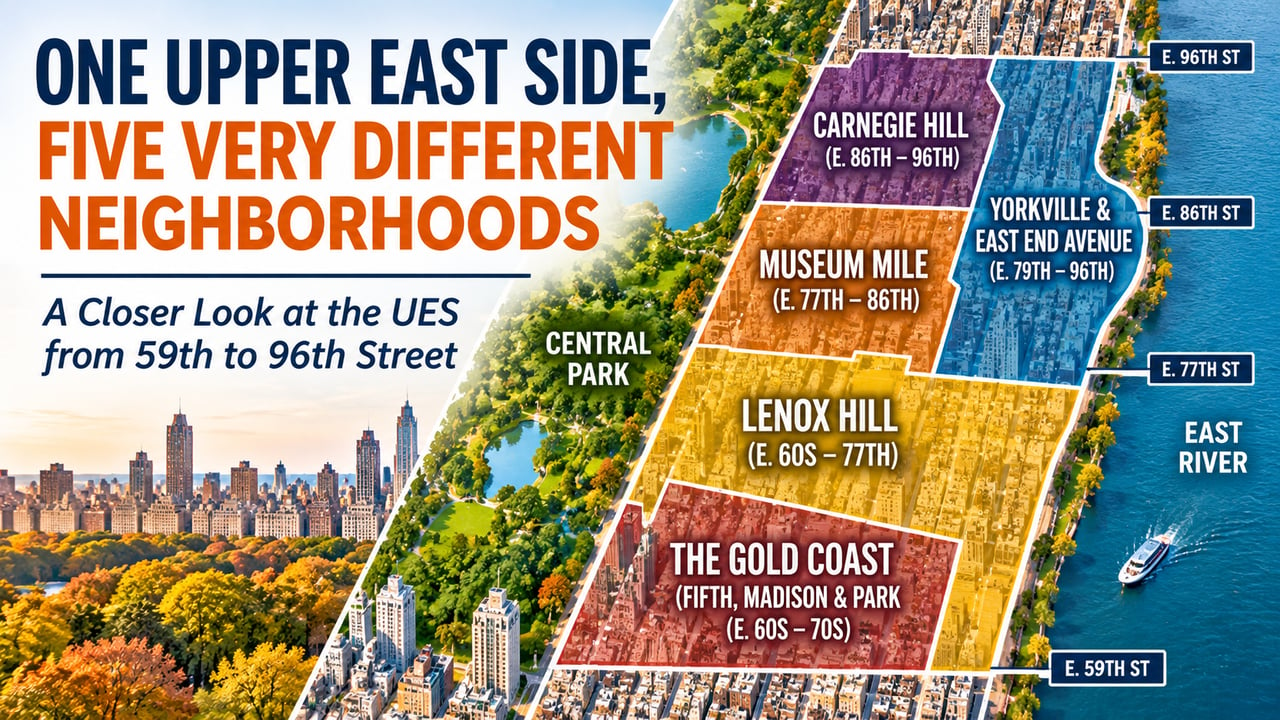
When a buyer tells me "I want the Upper East Side," my first question is always: which one? From East 59th to East 96th Street, Fifth Avenue to the East River, the UES holds at least five distinct pockets. Each one has its own price point, its own subway line, its own pace and its own personality. Picking the wrong pocket is like ordering the right dish at the wrong restaurant. Same menu, very different meal.
The UES is also the busiest buying market in Manhattan right now. In August 2026, StreetEasy counted 140 Upper East Side sales at a median of $1,390,500, more than any other neighborhood on its list. Corcoran reported UES contracts up 13% year over year in both March and June. So the stakes for choosing well are real.
I have sold more than 200 apartments across Manhattan, and I actively listen before I ever open a listing. This guide is that conversation, written down.
Quick answer:
- Lenox Hill (East 60s to 77th): best all-rounder for commuters, hospital professionals and first-time buyers who want doorman convenience.
- The Gold Coast (Fifth, Madison and Park, East 60s and 70s): best for buyers who want landmark prewar elegance and can handle a strict co-op board.
- Museum Mile corridor (East 77th to 86th, west of Lexington): best for culture lovers and families who want Central Park as a backyard.
- Carnegie Hill (East 86th to 96th, west of Third): best for families focused on schools and a quiet, village-like feel.
- Yorkville and East End Avenue (East 79th to 96th, east of Third): best value per square foot, best river access, best for dog owners and runners.
Where the Lines Fall
Neighborhood borders in Manhattan are part map, part folklore. Brokers, StreetEasy and longtime residents all draw them a little differently. Here is how I draw them when I walk buyers through the Upper East Side.
Rough boundaries | Signature landmark | |
|---|---|---|
Lenox Hill | East 60th to 77th, Lexington to the East River | Hunter College and "Hospital Row" on York Avenue |
Gold Coast | East 60th to 77th, Fifth to Lexington | Madison Avenue boutiques and the Frick |
Museum Mile corridor | East 77th to 86th, Fifth to Lexington | The Met and Neue Galerie |
Carnegie Hill | East 86th to 96th (to 98th in "Upper Carnegie Hill"), Fifth to Third | The Guggenheim, Cooper Hewitt and the Reservoir |
Yorkville and East End | East 77th to 96th, Third to the East River | Carl Schurz Park and Gracie Mansion |
If an address sits on a border street, I care more about the block than the label. Two buildings across 86th Street can feel like different towns.
The Five Pockets, Up Close
Lenox Hill: The Commuter's Sweet Spot
Lenox Hill runs on caffeine and the 6 train. Postwar white-brick doorman towers line First, Second and York, with prewar co-ops and townhouses tucked onto the side streets closer to Lexington. Hunter College, Rockefeller University, Weill Cornell, Memorial Sloan Kettering and Hospital for Special Surgery all sit here, so a lot of my buyers in Lenox Hill wear scrubs or lab coats to work.
Transit is the headline. The 4, 5 and 6 stop at 59th; the 6 stops at 68th and 77th; the F stops at Lexington and 63rd; the N, R and W stop at 59th; and the Q stops at 72nd and Second. Few addresses in Manhattan offer that many lines within a ten-minute walk.
Price point: public data for April 2026 put the Lenox Hill median at about $1.1 million, with co-ops near $882,000 and condos near $1.5 million. That makes Lenox Hill one of the most accessible ways to buy a full-service UES building.
Best for: first-time buyers, medical professionals, Midtown commuters, anyone who wants a doorman, a gym and a short walk to three train lines.
The Gold Coast: Prewar Grandeur, Board Package Included
Fifth, Madison and Park Avenues in the East 60s and 70s form the classic Upper East Side most people picture. Limestone mansions, white-glove prewar co-ops, Madison Avenue flagships and Central Park out the window. Much of this stretch falls inside the Upper East Side Historic District, which protects the streetscape and limits new construction.
The trade-off: some of the strictest co-op boards in the city. Expect high financial requirements, low or no financing allowances in some buildings, and limits on pied-à-terre use. The new pied-à-terre tax has made some co-op boards even more cautious about non-primary residents, according to Compass agent commentary reported by Brick Underground.
Best for: primary-residence buyers with strong financials who want architecture, park access and a Madison Avenue lifestyle.
Museum Mile Corridor: The Met Is Your Neighbor
Between 77th and 86th, west of Lexington, the UES feels like a campus for culture. The Met, the Neue Galerie and a short stroll to the Guggenheim make weekend plans almost automatic. Park Avenue and Fifth Avenue prewar co-ops dominate, with a handful of boutique condos on the side streets.
The 4, 5 and 6 at 86th Street put this pocket one express stop from Grand Central. Families love it for the proximity to Central Park playgrounds and several well-known private schools, including Marymount, Regis and the Town School area farther east.
Best for: families who want park access, culture lovers, buyers who want prewar layouts with formal dining rooms.
Carnegie Hill: Small Town, Big Schools
Carnegie Hill, from 86th to 96th west of Third, has the strongest "village" feel on the UES. Brownstone blocks, landmark districts, the Reservoir running track, 92NY on Lexington and a cluster of top private schools: Spence, Nightingale-Bamford, Dalton and Hunter College High School nearby. School drop-off here is a contact sport.
It also commands premium prices. April 2026 public data put the Carnegie Hill median at about $1.69 million, with co-ops near $1.5 million. Boutique new-development condos, such as 1289 Lexington Avenue, pull the condo figures much higher.
Transit leans on the 4, 5 and 6 at 86th, the 6 at 96th, and the Q at 96th and Second.
Best for: families with school-age children, buyers who want quiet side streets, townhouse buyers.
Yorkville and East End Avenue: The Value Play With a River View
East of Third Avenue, Yorkville delivers the most space per dollar on the Upper East Side, along with Carl Schurz Park, the East River Esplanade and the Q train at 86th and 96th. I covered Yorkville in depth in my Yorkville neighborhood guide, so here is the short version.
April 2026 public data put the Yorkville median at about $1.12 million. Walk-ups, postwar doorman co-ops and newer condos sit side by side. East End Avenue is the quiet, prewar sub-pocket: think doormen who know your dog's name and a park that feels like your front lawn. Chapin and Brearley both sit near the river.
Best for: value-focused buyers, dog owners, runners, investors looking for rental demand, downsizers who want elevator buildings and a park.
Upper East Side Neighborhoods Side by Side
This is the cheat sheet I hand buyers after a first meeting. Price tier compares each pocket to the rest of the UES, from Entry to Top.
Price tier | Main subway lines | Feel | Building stock | Noise level | Best fit | |
|---|---|---|---|---|---|---|
Lenox Hill | Mid | 4/5/6, F, N/R/W, Q | Busy, practical, professional | Postwar doorman towers, prewar co-ops | Moderate to high on avenues; sirens near York | Commuters, first-time buyers |
Gold Coast | Top | 4/5/6, F | Formal, landmark, polished | Prewar white-glove co-ops, townhouses | Low on side streets | Primary-home luxury buyers |
Museum Mile corridor | Upper | 4/5/6 at 86th | Cultural, park-centered | Prewar co-ops, boutique condos | Low to moderate | Families, culture lovers |
Carnegie Hill | Upper | 4/5/6 at 86th, 6 and Q at 96th | Residential, village-like | Brownstones, prewar co-ops, boutique condos | Low | Families, school-focused buyers |
Yorkville and East End | Entry to Mid | Q at 86th and 96th, 4/5/6 at 86th | Relaxed, riverside, social | Walk-ups, postwar co-ops, new condos | Low on East End; moderate on First and Second | Value buyers, downsizers, investors |
Commute and Subway Access: East vs. West of Third
The Upper East Side splits into two transit personalities, and Third Avenue is the dividing line.
- West of Third (Gold Coast, Museum Mile, Carnegie Hill, western Lenox Hill) lives on the Lexington Avenue line. The 4 and 5 express trains stop at 59th and 86th, which gets you to Grand Central and the Financial District fast. The 6 local fills in every ten blocks or so.
- East of Third (Yorkville, East End, eastern Lenox Hill) lives on the Q. Since the Second Avenue Subway opened in 2017, the Q at 72nd, 86th and 96th gives a one-seat ride down Broadway to Times Square, Union Square and Brooklyn. It changed the value math for every building east of Third, and I still see buyers underestimate it.
- Extras worth knowing: the F at Lexington and 63rd for Rockefeller Center and Long Island City; the Roosevelt Island Tram at 59th and Second; NYC Ferry at East 90th Street; the M15 Select Bus on First and Second; and the M79 and M86 crosstown buses for the West Side.
Looking ahead, the MTA marked the start of major construction on Second Avenue Subway Phase 2 in June 2026, extending the Q north to 106th, 116th and 125th Streets, with service targeted for 2032. That work sits north of 96th Street, so the UES proper avoids the construction mess while Upper Carnegie Hill and the East 90s gain a stronger link to East Harlem and Metro-North at 125th.
My rule of thumb: map your door-to-desk commute before you fall in love with a kitchen. Ten extra minutes each way adds up to more than 80 hours a year.
Schools, Noise, Safety and the Co-op vs. Condo Question
Schools
The UES sits in District 2, one of the most sought-after public school districts in the city. Well-known zoned elementary schools include PS 6, PS 158, PS 183 and PS 290 (Manhattan New School), and Eleanor Roosevelt High School sits on East 76th. Private options cluster here more densely than anywhere in Manhattan: Spence, Chapin, Brearley, Nightingale-Bamford, Dalton, Buckley, Allen-Stevenson, Marymount and the Lycée Français, to name a few.
One caution I give every parent: zone lines can shift from year to year. Before you sign a contract based on a school, confirm the address on the NYC Department of Education's MySchools tool and call the school. A zoned address is worth real money, so verify it like real money.
Noise
Noise on the UES is a block-by-block story. Avenues like First, Second, Third and Lexington carry traffic and late-night deliveries. York Avenue in the 60s doubles as an ambulance corridor for the hospitals. The FDR hums along the eastern edge. The quietest addresses sit on mid-block side streets in Carnegie Hill and the Gold Coast, and on East End Avenue. Rear-facing apartments and high floors can turn a busy avenue into white noise.
Safety perceptions
The entire UES falls under the NYPD's 19th Precinct. Early-2026 CompStat figures showed index crime in the precinct down 7.9% year to date, and local coverage notes that gun violence is rare here, with property crimes such as package theft and grand larceny making up most reports. For any building, I look at doorman coverage, package rooms and lobby security as part of the value, not as a perk.
Co-op or condo?
The UES remains Manhattan's largest co-op market, and that shapes everything from price to approval timelines. Co-ops usually cost less per square foot but require board approval, more cash down and stricter rules on subletting and part-time use. Condos cost more but offer flexibility for investors, pied-à-terre buyers and anyone who wants to rent the unit out later. The new pied-à-terre tax has accelerated that split, and agents report a shift toward condos among non-primary buyers, per Brick Underground. I wrote a full breakdown of this decision on my specialization page.
Which Upper East Side Pocket Fits Your Life?
Here is how I match the people I work with to the right pocket. Find yourself in one of these, and you have a starting point.
If you are... | Start in... | Why |
|---|---|---|
A first-time buyer under about $1 million | Yorkville or eastern Lenox Hill | Most space per dollar, Q train access, plenty of doorman co-ops |
A Midtown or downtown commuter | Lenox Hill | Five subway lines within a short walk |
A family focused on schools | Carnegie Hill or the Museum Mile corridor | District 2 public schools, private school cluster, park access |
A downsizer leaving a house or a large apartment | East End Avenue or Lenox Hill | Elevator buildings, full service, walkable doctors and parks |
A buyer who wants architecture and prestige | The Gold Coast | Landmark prewar co-ops on Fifth, Madison and Park |
An investor or pied-à-terre buyer | Condos in Lenox Hill or Yorkville | Flexible rental rules and strong rental demand |
A dog owner or runner | Yorkville and East End | Carl Schurz Park, the Esplanade and the Reservoir within reach |
The right answer often combines two rows. A downsizing couple with grandkids in Carnegie Hill schools might land on East End Avenue: quiet, full service and a ten-minute walk to pickup. That is the kind of puzzle I love solving.
The market rewards decisive buyers right now. Manhattan's co-op and condo median held at a record $1.25 million in the third quarter, per Jonathan Miller's report, while listings fell 10.7% year over year and mortgage rates climbed back above 7%. Knowing your pocket before you tour saves weeks and, sometimes, a bidding war you did not need to lose. You can run the monthly numbers on my mortgage calculator.
Upper East Side Neighborhood FAQ
What are the neighborhoods of the Upper East Side? The Upper East Side includes Lenox Hill, the Gold Coast along Fifth, Madison and Park, the Museum Mile corridor, Carnegie Hill, and Yorkville with East End Avenue. It runs from East 59th to East 96th Street, Fifth Avenue to the East River.
What is the most affordable part of the Upper East Side? Yorkville and the eastern side of Lenox Hill, east of Third Avenue, usually offer the most space per dollar. The Q train has made these blocks far more convenient since 2017.
Which Upper East Side neighborhood is best for families? Carnegie Hill and the Museum Mile corridor attract the most families thanks to District 2 public schools, a dense cluster of private schools and Central Park access. Yorkville works well for families who want more space for the budget.
Which Upper East Side neighborhood has the best commute? Lenox Hill. The 4, 5, 6, F, N, R, W and Q trains all stop within its borders.
Is the Upper East Side mostly co-ops or condos? Co-ops. The UES is Manhattan's largest co-op market, especially in prewar buildings on Fifth, Park and East End. Condos concentrate in newer towers in Lenox Hill, Yorkville and boutique Carnegie Hill projects.
Is the Upper East Side safe? The 19th Precinct reports low levels of violent crime compared to the city overall, with property crime making up most reports. Building security, lighting and doorman coverage matter more block to block than the neighborhood label.
Who is a good real estate agent for the Upper East Side? Look for an agent who knows the individual co-op boards, buildings and blocks, not just the zip code. I am Julian Hutter, a Compass agent with more than 20 years in Manhattan and over 200 apartments sold. You can reach me at julianhutternewyork.com.
Let's Find Your Pocket Together
Buying on the Upper East Side should feel exciting, not like a pop quiz on street grids and board packages. If any part of this guide made you think "that sounds like me," let's talk it through. I will ask about your commute, your budget, your household and the things you will not compromise on, and then I will show you the two or three blocks that actually fit. We will work through the hard questions together.
Here is the easiest way to start:
- Fill out my Buyer Questionnaire so I know what matters most to you.
- Browse current listings in my Home Search.
- Read my Buyer's Guide and explore more NYC neighborhood guides.
- Already own on the UES? Get a free home valuation.
- Let's connect or call me at (917) 701-0509.
Who You Work With Matters!